

Oliver Cromwell gold broad 1656 of twenty shillings
Library
BACKGROUND:
In the summer of 1642 civil war
broke out in England under the reign of Charles I.
On 30 January 1649 Charles I, who
was king of England, Scotland and Ireland from 1625-1649 was
publicly
beheaded
at Whitehall London, being the first and only English monarch to be
lawfully
executed. Charles I had been tried for treason and his death
warrant had
been
signed by three persons which included Oliver Cromwell.
The trial and execution of
Charles I was one of the most controversial events in history.
Charles I
was to
be tried by 135 Judges but only 68 turned up for the trial. No
one
wanted to be
the Chief Judge for the trial and eventually the position was allocated
to John
Bradshaw who was a lawyer. John Bradshaw knew that putting the
king on
trial for
treason was not popular and fearing for his own life he made a special
hat
which had metal inside it to protect his head against any attack.
At the trial Charles I refused to
defend himself or to take off his own hat which was an insult to the
Court. The
Court was packed with soldiers and when the judgment of the Court was
read out
Charles I then tried to defend himself but was told his chance to do so
had
gone and he was bundled out of the court room and executed three days
later.
On the day of the execution the
sentence was delayed till the afternoon as the man who was allocated to
execute
the King refused to do so for fear of
future reprisals. Eventually an executioner and an
assistant were
found
and paid 100 pounds on the condition that they wore masks to hide their
identity.
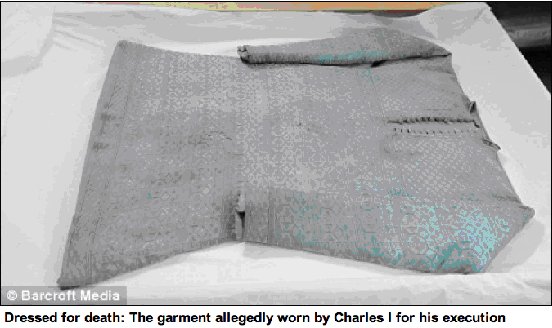
At his execution Charles I worn a
heavy tunic/waistcoat as he did not want to let the crowd see if he
trembled
prior to his execution. The tunic with its blood stains still
present
can be
found in the Museum of London and is shown below:
The execution was attended by the
Royal surgeon who subsequently sewed the King’s head back on to his
neck prior
to his secret burial in Windsor Castle without any religious service.
After the execution Charle’s
family, including his eldest son who also was
named Charles fled to Europe, where they sought and obtained
refuge.
On 6 February 1649 the monarchy
was formally abolished by Act of Parliament and what became known as a
Council
of State was set up with Oliver Cromwell as its first chairman.
Thus the Commonwealth of
England, Ireland and Scotland came about as a result of the Civil War
and
execution of Charles I.
King Charles 1 had been his own
worst enemy. He was self-righteous, arrogant and unscrupulous and
made
many bad
decisions since ascending the throne in 1625 on the death of his father
James
I. During his reign he alienated both his subjects and his
Parliament,
prompting
a series of events that ultimately lead to the Civil wars, his own
death
and the
abolition of the English monarchy for more than a decade.
His marriage to a Roman-Catholic
French Princess Henrietta in 1625 did not please his Protestant
subjects and in
1637 he totally misgauged the sentiments of his Scottish subjects when
he
attempted to impose an Anglican form of worship on the predominantly
Presbyterian population in Scotland.
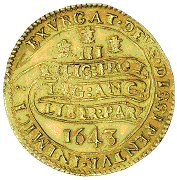
Charles I produced many wonderful
coins during his reign including the Gold triple unite from 1642-1646
and these
coins stand in marked contrast to the coinage of the Commonwealth
period of
1649-1660.

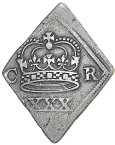
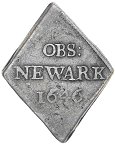
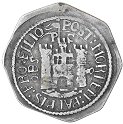
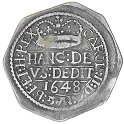
Towards the end of the reign of
Charles 1 some coinage commenced to change in certain parts of England,
due to
the disruption of the Civil War, when the now famous siege coins of
Charles I
came into production from 1645 onwards.


The coinage struck during the
Commonwealth period was totally different from previous coins, in that
they had
inscriptions written in English rather than Latin which was considered
to be
too close a connection to the Pope. Further English was the
language of
the
ordinary population.
In addition there was now no
monarch to place on the coins and the St.George’s cross and Irish harp
took the
place of the royal arms.
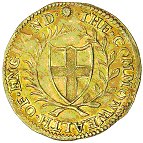
The new coins had common designs
for all denominations, from the gold twenty shillings down to the
silver
penny,
with a simplified version for the tiny half penny. The first
coinage was
dated
1649 and up until 1657 the mint mark was the sun which was replaced by
an
anchor on coins from 1658 to 1660.
The coins bore the inscriptions
“The Commonwealth of England” on one side with the date and “God with
us” on
the other side.
The mint mark was altered from
the sun in 1658 following the death of Oliver Cromwell to an anchor
which
remained on the coins until 1660.
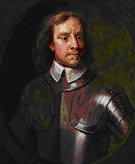
Oliver Cromwell played a major
part in the formation of the Commonwealth. Cromwell was born in
1599 and
in 1616
attended Cambridge University but had to leave the following year, due
to the
death of his father. In 1628 Cromwell was elected a Member of
Parliament
and
during the civil war he was appointed a lieutenant general in the New
Model
Army which fought against the Royalists.

During the Commonwealth period
there was some advancement in the production of coins when the
Frenchman Pierre
Blondeau was summoned to London to produce certain machine made trial
coins in 1651,
which had either milled edges or inscribed edges with Blondeau’s name
and “
Truth and Peace”. The purpose of this development was to try and
stop
coins
being clipped and to reduce counterfeiting.


“Truth and Peace” [olive branch] Petrvs
Blondaeus Inventor Fecit [palm branch]
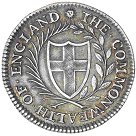
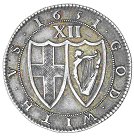
Blondeau
pattern miller silver shilling 1651 with milled edge
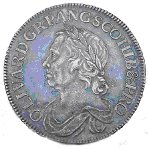
1658
Oliver Cromwell crown with obverse die crack
RESTORATION OF THE MONARCHY:
About one year later Charles II
returned to England and the monarchy was restored.
Meanwhile the coins of the
Commonwealth were allowed to circulate but on 7 September 1661 it was
proclaimed that such coinage would cease to be current from the end of
November
1661 after which they had to be taken to the Mint to be exchanged for
an equal
quantity of lawful money.
Many reprisals were carried out
by Charles II for his father’s execution and on 30 January 1661, Oliver
Cromwell’s body was dug up and was symbolically executed, before being
buried
again at Tyburn, as was the body of John Bradshaw. Nine persons
who were
still
living and associated with the execution were hung, drawn and
quartered. Others
were given life imprisonment or simply excluded from office for life.
Coinage reverted to the
traditional coins of the monarchy with the king’s head on the obverse.
Charles II died in February 1685
and although he had at least twelve illegitimate children, his wife
bore
no
children and accordingly the monarchy passed to his brother James II.
The coinage of Charles II from
1663 onwards were made by the presses of Blondeau with milled edges
which
superseded the ancient hand hammering process.
ROBERT TONNER.
June 2012