Numismatics
and the Covid 19 Pandemic
The Patron’s Address 2021
John Pearn
An Address Presented at the National Biennial Conference
of the
Australian Numismatic Society

Held at
Coffs Harbour, New South Wales
12-13 June 2021
The Patron’s Address 2021
John Pearn
An Address Presented at the National Biennial Conference
of the
Australian Numismatic Society
Held at
Coffs Harbour, New South Wales
12-13 June 2021
Major
General Professor John Pearn AO RFD MD
Patron, Australian Numismatic Society
Office of the Senior Paediatrician,
Room 809, Centre for Children’s Health Research
Queensland Children’s Hospital, South Brisbane, QLD 4101
j.pearn@uq.edu.au
Patron, Australian Numismatic Society
Office of the Senior Paediatrician,
Room 809, Centre for Children’s Health Research
Queensland Children’s Hospital, South Brisbane, QLD 4101
j.pearn@uq.edu.au
Introduction
Turmoil engulfed the world in March 2020 as the coronavirus, Covid 19, became established as a world-wide pandemic.
Millions of lives were lost, livelihoods were destroyed, social intercourse was hugely modified and personal lives were
changed, many forever.
Not since the 1918-19 “Spanish flu” pandemic swept the world, had there been such societal disruption.1
Every community, every profession, and every individual saw the patterns of life changed, some greatly so.
Those otherwise forced to remain isolated at home, who enjoyed a hobby, found some compensation in being able to
spend more time in concentrating on their special interest. Those who delight in the world of numismatics found time –
often uninterrupted time – to indulge in the art and science of the world of coins, medals, medallions, banknotes and badges.
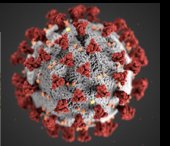
Electron micrograph of the Covid-19 virus particle.
For many, personal numismatic collections have never been so well sorted, classified and presented. For some, new
research themes have evolved and papers have been produced which would otherwise never have seen the light of day.
Numismatics of the Covid Pandemic
Surprisingly, very few numismatic pieces have been issued to commemorate the 2019-2021 Covid pandemic. Two notable
exceptions were the Conference Medals commissioned and struck by the Royal Numismatic Society of New Zealand. These
were commissioned for distribution on the occasion of its Third International Conference, held in Wellington, New Zealand,
from 16 to 19 October 2020. These fine Conference Medals were commissioned and struck by the Royal New Zealand
Numismatic Society to commemorate the 90th Anniversary of its foundation.2
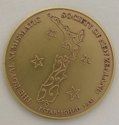
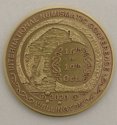
Royal New Zealand Numismatic Society Conference Medals 2020
The Royal Numismatic Society of New Zealand struck two Conference Medals from similar dies – the Conference Medal
for registrants at the International Conference; and the Presenter’s Medal. Both featured, in the exerge, three stylised
electron micrographic images of Covid-19 virus particles. The virus can be visualised in the laboratory by scanning electron
microscopy. The virus is a sphere with a diameter between 70 and 85 nanometres, “with spikes on the surface of the spherical
virion which impart the look of a corona, when viewed microscopically” – hence the name.
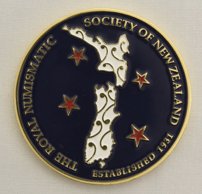
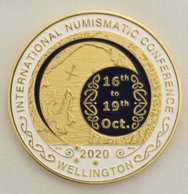
Presenter’s Medal. The Royal Numismatic Society of New Zealand International Conference 16-19 October 2020.
One of 41 presented to speakers at the Conference, held in Wellington, New Zealand. 45 mm x 3 mm,40 grams.
The medal presented to the author in absentia, November 2020.
The Obverse of the medals portrays, at the centrum, a stylised image of the three main islands of New Zealand, embellished with
a simple linear Maori motif. The image is embedded in the four-start representation of the Southern Cross. This national symbol
of New Zealand differs from the ubiquitous Australian five-star portrayal of the Southern Cross, in that the constellation of Epsilon
is omitted. In the surround are the words, “The Royal Numismatic Society of New Zealand Established 1931”. The Reverse of the
Medals have, at their centrum, a stylised map of Port Nicholson on which the City of Wellington stands. In the exerge is the date,
2020, and three virus particles of Covid 19.
The medals are discs of tombac (a bronze alloy), 45 mm x 3mm, and weigh 40 grams. Eighty Conference Medals and 41 Presenter’s
Medals were struck. The Presenter’s Medal is of identical size and weight to the Conference Medal, but features multi-coloured
red infill which highlights the stars of the constellation of the Southern Cross; and white enamel infill for the map of New Zealand.
The Reverse was finished in white enamel with black infill. The 41 Presenter’s Medals portray the three Covid-19 corona virus
images highlighted in gold enamel.
In contrast with the rarity of medals, many institutions have produced badges, almost always “tinnies”, to highlight the importance
of the preventive medicine imposts of social distancing, the wearing of masks, and of immunisation. One such badge was the piece
presented gratis to employees of Queensland Health following their initial covid immunisation. Undoubtedly, collections of these
types of badges will feature in numismatic conferences in the future.

Badge issued by Queensland Health in 2021.37 mm, magnet affixation.
Memorialisation of Epidemics
Our philatelic colleagues have been more proactive in creating a permanent record of the 2019-21 Covid pandemic, when compared
with those who delight in the numismatic world. Postage stamps are the medium which provides the most extensive outreach for
memorialisation; whereas medals and coins are the most enduring. 2

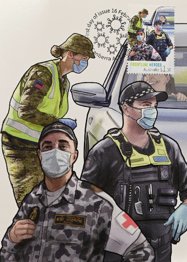
Maximum Cards issued by Australia Post, as pre-stamped First Day of Issue items.
On 16 February 2021, Australia Post issued five postage stamps, Maximum Cards and First Day Covers to commemorate the
altruistic service of those in the front line of care and treatment of the victims of the corona virus.3
In 2008, the Royal Australian Mint Issued a One-Dollar Coin to Commemorate the Centenary of Quarantine in Australia.
It was issued as a PNC in conjunction with Australia Post.
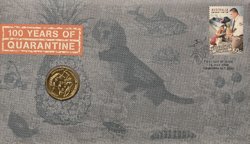
A PNC, issued conjointly by Australia Post and the Royal Australian Mint on 15 July 2008.
The specifications of the coin were a disc 25 mm in diameter and of aluminium bronze weighing 9 grams. It depicted, on the
Reverse, a beagle detector dog of the Australian Quarantine and Inspection Service. The detector dog stands beside a stylised
map of Australia:

“… represented in the shape of a suitcase with luggage stickers identifying the key hazards that the Australian Quarantine
and Inspection Service protects Australia from”.4
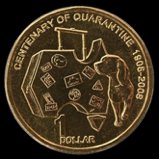
The 2008 issue of the one-dollar coin to commemorate the centenary of the Australian Quarantine and Inspection Service.
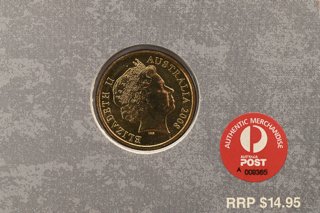
The Obverse of the Centenary of Quarantine One-Dollar Coin Issued by the Royal Australian Mint on 15 July 2008.
Issued As a PNC in conjunction with Australia Post.
Conclusion
The numismatic issues, throughout the world, will memorialise the 2020-2021 Covid 19 pandemic, as enduring memorials of a pandemic
which challenged world order. Devastating plagues have been known since the time of ancient Greece.5
There is a significant numismatic history of plague and quarantine medals. In some ways, they resemble siege (or obsidional) medals.
The medals and coins of Antoninus Pius (138-161 A.D.) commemorate the summoning of the Roman god of curative medicine, Aesculapius,
to Rome in 293-292 BC to quell the plague of that era.6 Medallists in Hungary struck three plague medals in 1531; and another to
commemorate the Centenary (in 1832) of another plague which had struck that nation in 1732.7 In England, medals were struck in
1572 in London to commemorate Queen Elizabeth I’s recovery from smallpox. The Queen Elizabeth Phoenix Badge (1574) also
commemorates her recovery from smallpox, in a flattering role, with the metaphor of the phoenix rising from near-death during the
smallpox plague of that year. 8 A single medal, of silver, was struck in 1666 to commemorate the devastating plague and fire of London
of that year. The Obverse portrays St Paul securing a viper (a metaphor for the plague), with new life depicted in the form of a tree
springing from the earth. 9
So too, will the numismatic pieces of 2020 and 2021 endure as heritage records of a devastating pandemic, as in the past, not only to
individual life and health but to the order of society.
Acknowledgement
I thank Mr Lachlan Dale, senior medical photographer of the Queensland Children’s Hospital, Brisbane, for his skill and help.
Biographic Note
Major General Professor John Pearn is the long-serving Patron (from 2006) of the Australian Numismatic Society. He is an active
Member of the Queensland Branch of the Australian Numismatic Society and an Honorary Member of the Queensland Numismatic
Society; and is the author of numerous scholarly papers on numismatics. In his professional life, he is the senior paediatrician at the
Queensland Children’s Hospital, Brisbane. He has served as a senior consultant paediatrician at the Children’s Hospitals, based in
Brisbane, for more than five decades. A doctor-soldier and former Surgeon General to the Australian Defence Force (1998-2000),
he is also a professional historian. He has commissioned and designed more than 30 commemorative medals, particularly in the
domain of Australian healthcare.
References
1. Pearn, John. Invisible Victims: Queensland Children and the 1919 Influenza Pandemic. Qld Hist J 2020; 24:399-409.
2. Pearn ,John. The numismatics and philately of the Burke and Wills Expedition 1860-1861. Qld Hist J 2021; (in press).
3. Australia Post. First Day of Issue PNC Envelope, Stamp and Coin Titled “100 Years of quarantine”. First Day of Issue 15 July 2008.
4. [Editor]. Centenary of the Australian Quarantine. Mint Issue (J Royal Australian Mint) 2008; May (No.74): 8.h
5. Pearn, John. “Fumigated Philately”. Quarantine and Medical Themes of Fumigated Mail. Bull Numismatic Soc Qld 2020; 43 (7): 5-8.
6. Penn RG. Medicine on Ancient Greek and Roman Coins. London, Seaby BT Batsford Ltd, 1994:37.
7. Huszar L, Varannai G. Medicina in Nummis. Hungarian Coins Related to Medicine. Budapest, Semmelweis Medical Historical Museum, Library and Archives, 1997:87.
8. Whiting JRS. Commemorative Medals. A Medallic History of Britain from Tudor Times to the Present Day. Newton Abbott (Devon UK), David and Charles, 1972:28, 29.
9. Whiting JRS. Ibid.: 65.
Turmoil engulfed the world in March 2020 as the coronavirus, Covid 19, became established as a world-wide pandemic.
Millions of lives were lost, livelihoods were destroyed, social intercourse was hugely modified and personal lives were
changed, many forever.
Not since the 1918-19 “Spanish flu” pandemic swept the world, had there been such societal disruption.1
Every community, every profession, and every individual saw the patterns of life changed, some greatly so.
Those otherwise forced to remain isolated at home, who enjoyed a hobby, found some compensation in being able to
spend more time in concentrating on their special interest. Those who delight in the world of numismatics found time –
often uninterrupted time – to indulge in the art and science of the world of coins, medals, medallions, banknotes and badges.
Electron micrograph of the Covid-19 virus particle.
For many, personal numismatic collections have never been so well sorted, classified and presented. For some, new
research themes have evolved and papers have been produced which would otherwise never have seen the light of day.
Numismatics of the Covid Pandemic
Surprisingly, very few numismatic pieces have been issued to commemorate the 2019-2021 Covid pandemic. Two notable
exceptions were the Conference Medals commissioned and struck by the Royal Numismatic Society of New Zealand. These
were commissioned for distribution on the occasion of its Third International Conference, held in Wellington, New Zealand,
from 16 to 19 October 2020. These fine Conference Medals were commissioned and struck by the Royal New Zealand
Numismatic Society to commemorate the 90th Anniversary of its foundation.2
Royal New Zealand Numismatic Society Conference Medals 2020
The Royal Numismatic Society of New Zealand struck two Conference Medals from similar dies – the Conference Medal
for registrants at the International Conference; and the Presenter’s Medal. Both featured, in the exerge, three stylised
electron micrographic images of Covid-19 virus particles. The virus can be visualised in the laboratory by scanning electron
microscopy. The virus is a sphere with a diameter between 70 and 85 nanometres, “with spikes on the surface of the spherical
virion which impart the look of a corona, when viewed microscopically” – hence the name.
Presenter’s Medal. The Royal Numismatic Society of New Zealand International Conference 16-19 October 2020.
One of 41 presented to speakers at the Conference, held in Wellington, New Zealand. 45 mm x 3 mm,40 grams.
The medal presented to the author in absentia, November 2020.
The Obverse of the medals portrays, at the centrum, a stylised image of the three main islands of New Zealand, embellished with
a simple linear Maori motif. The image is embedded in the four-start representation of the Southern Cross. This national symbol
of New Zealand differs from the ubiquitous Australian five-star portrayal of the Southern Cross, in that the constellation of Epsilon
is omitted. In the surround are the words, “The Royal Numismatic Society of New Zealand Established 1931”. The Reverse of the
Medals have, at their centrum, a stylised map of Port Nicholson on which the City of Wellington stands. In the exerge is the date,
2020, and three virus particles of Covid 19.
The medals are discs of tombac (a bronze alloy), 45 mm x 3mm, and weigh 40 grams. Eighty Conference Medals and 41 Presenter’s
Medals were struck. The Presenter’s Medal is of identical size and weight to the Conference Medal, but features multi-coloured
red infill which highlights the stars of the constellation of the Southern Cross; and white enamel infill for the map of New Zealand.
The Reverse was finished in white enamel with black infill. The 41 Presenter’s Medals portray the three Covid-19 corona virus
images highlighted in gold enamel.
In contrast with the rarity of medals, many institutions have produced badges, almost always “tinnies”, to highlight the importance
of the preventive medicine imposts of social distancing, the wearing of masks, and of immunisation. One such badge was the piece
presented gratis to employees of Queensland Health following their initial covid immunisation. Undoubtedly, collections of these
types of badges will feature in numismatic conferences in the future.
Badge issued by Queensland Health in 2021.37 mm, magnet affixation.
Memorialisation of Epidemics
Our philatelic colleagues have been more proactive in creating a permanent record of the 2019-21 Covid pandemic, when compared
with those who delight in the numismatic world. Postage stamps are the medium which provides the most extensive outreach for
memorialisation; whereas medals and coins are the most enduring. 2
Maximum Cards issued by Australia Post, as pre-stamped First Day of Issue items.
On 16 February 2021, Australia Post issued five postage stamps, Maximum Cards and First Day Covers to commemorate the
altruistic service of those in the front line of care and treatment of the victims of the corona virus.3
In 2008, the Royal Australian Mint Issued a One-Dollar Coin to Commemorate the Centenary of Quarantine in Australia.
It was issued as a PNC in conjunction with Australia Post.
A PNC, issued conjointly by Australia Post and the Royal Australian Mint on 15 July 2008.
The specifications of the coin were a disc 25 mm in diameter and of aluminium bronze weighing 9 grams. It depicted, on the
Reverse, a beagle detector dog of the Australian Quarantine and Inspection Service. The detector dog stands beside a stylised
map of Australia:
“… represented in the shape of a suitcase with luggage stickers identifying the key hazards that the Australian Quarantine
and Inspection Service protects Australia from”.4
The 2008 issue of the one-dollar coin to commemorate the centenary of the Australian Quarantine and Inspection Service.
The Obverse of the Centenary of Quarantine One-Dollar Coin Issued by the Royal Australian Mint on 15 July 2008.
Issued As a PNC in conjunction with Australia Post.
Conclusion
The numismatic issues, throughout the world, will memorialise the 2020-2021 Covid 19 pandemic, as enduring memorials of a pandemic
which challenged world order. Devastating plagues have been known since the time of ancient Greece.5
There is a significant numismatic history of plague and quarantine medals. In some ways, they resemble siege (or obsidional) medals.
The medals and coins of Antoninus Pius (138-161 A.D.) commemorate the summoning of the Roman god of curative medicine, Aesculapius,
to Rome in 293-292 BC to quell the plague of that era.6 Medallists in Hungary struck three plague medals in 1531; and another to
commemorate the Centenary (in 1832) of another plague which had struck that nation in 1732.7 In England, medals were struck in
1572 in London to commemorate Queen Elizabeth I’s recovery from smallpox. The Queen Elizabeth Phoenix Badge (1574) also
commemorates her recovery from smallpox, in a flattering role, with the metaphor of the phoenix rising from near-death during the
smallpox plague of that year. 8 A single medal, of silver, was struck in 1666 to commemorate the devastating plague and fire of London
of that year. The Obverse portrays St Paul securing a viper (a metaphor for the plague), with new life depicted in the form of a tree
springing from the earth. 9
So too, will the numismatic pieces of 2020 and 2021 endure as heritage records of a devastating pandemic, as in the past, not only to
individual life and health but to the order of society.
Acknowledgement
I thank Mr Lachlan Dale, senior medical photographer of the Queensland Children’s Hospital, Brisbane, for his skill and help.
Biographic Note
Major General Professor John Pearn is the long-serving Patron (from 2006) of the Australian Numismatic Society. He is an active
Member of the Queensland Branch of the Australian Numismatic Society and an Honorary Member of the Queensland Numismatic
Society; and is the author of numerous scholarly papers on numismatics. In his professional life, he is the senior paediatrician at the
Queensland Children’s Hospital, Brisbane. He has served as a senior consultant paediatrician at the Children’s Hospitals, based in
Brisbane, for more than five decades. A doctor-soldier and former Surgeon General to the Australian Defence Force (1998-2000),
he is also a professional historian. He has commissioned and designed more than 30 commemorative medals, particularly in the
domain of Australian healthcare.
References
1. Pearn, John. Invisible Victims: Queensland Children and the 1919 Influenza Pandemic. Qld Hist J 2020; 24:399-409.
2. Pearn ,John. The numismatics and philately of the Burke and Wills Expedition 1860-1861. Qld Hist J 2021; (in press).
3. Australia Post. First Day of Issue PNC Envelope, Stamp and Coin Titled “100 Years of quarantine”. First Day of Issue 15 July 2008.
4. [Editor]. Centenary of the Australian Quarantine. Mint Issue (J Royal Australian Mint) 2008; May (No.74): 8.h
5. Pearn, John. “Fumigated Philately”. Quarantine and Medical Themes of Fumigated Mail. Bull Numismatic Soc Qld 2020; 43 (7): 5-8.
6. Penn RG. Medicine on Ancient Greek and Roman Coins. London, Seaby BT Batsford Ltd, 1994:37.
7. Huszar L, Varannai G. Medicina in Nummis. Hungarian Coins Related to Medicine. Budapest, Semmelweis Medical Historical Museum, Library and Archives, 1997:87.
8. Whiting JRS. Commemorative Medals. A Medallic History of Britain from Tudor Times to the Present Day. Newton Abbott (Devon UK), David and Charles, 1972:28, 29.
9. Whiting JRS. Ibid.: 65.