Thessaly
- The Thessalian League
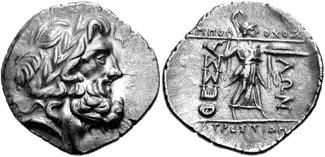

Following the Roman Republic’s defeat of Macedon at Kynoskephalai in 197 BC, T. Quinctius Flamininus, the victorious general, headed a senatorial commission set up to establish a protectorate in Greece. As a diplomatic gesture, he pronounced at the Isthmian Games in July of the following year that those Greek areas (including Thessaly) which were formerly under Macedonian control were now free (Polyb.18.46.5). Flamininus then revived an independent Thessalian League, which had been under the control of the Macedonian king since the time of Philip II. Reorganized along the pre-Macedonian, Archaic period model, this new version was relatively autonomous and now included neighboring Thessalian districts as members. Achaia Phthiotis joined the League in 196 BC, Malis in 189 BC, Perrhaibia in 146 BC, and Ainis, Dolopia, and Oitaia sometime after 30 BC. During the crisis of 146 BC, when the rest of Greece was reduced to the status of a Roman province, the Thessalian League continued to exist as an ally of Rome. Although the Thessalian League appeared to exist in some form or other throughout the Roman Empire, it had become a purely ceremonial body that provided positions for the local elite and its subsequent history became intertwined with that of Thessaly proper. This series, comprised solely of silver coinage in three denominations (stater, drachm, and hemidrachm/obol), was the first truely Thessalian League "federal" coinage. All issues bore the ethnic ΘΕΣΣΑΛΙΩΝ, along with the responsible magistrates' names, and were likely minted at Larissa, the captial of the League. The types employed were few, but all are familiar types appearing on various Thessalian coinages during the previous two hundred years: Zeus, Apollo, Athena Itonia (the "Thessalian Pallas"), and the bridled horse. Unfortunately, this federal coinage also was the last Thessalian coinage to ever be minted.
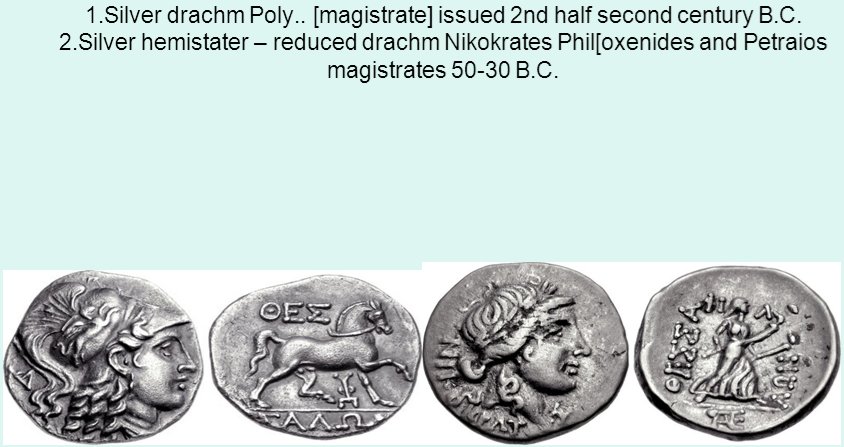
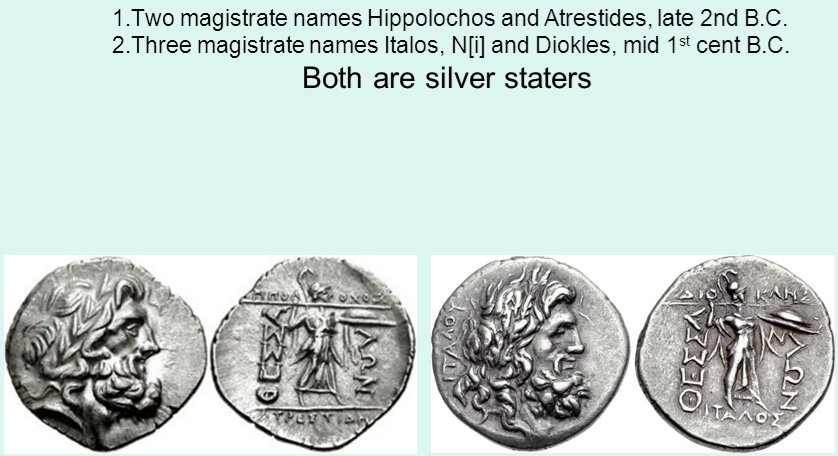
Under this later incarnation of the Thessalian League, the office of archon tagos (ἄρχων ταγός) was replaced by that of of an annual strategos (στρατηγός). Each strategos could be re-elected. In addition to the other administrative roles of the strategos, all documents were dated by his period of rule and his name inscribed on that year’s silver staters. Eusebius (FrGrHist. 260, F31.8) lists the strategoi for the first seventeen years of the reconstituted League. What is known of the remaining strategoi comes from the coinage. For a detailed study of the strategoi of the reconstituted Thessalian League, and its coinage during the i The terminal date of the series is tied to the end of Thessaly proper, when it was incorporated by the Romans into the new province of Macedonia.
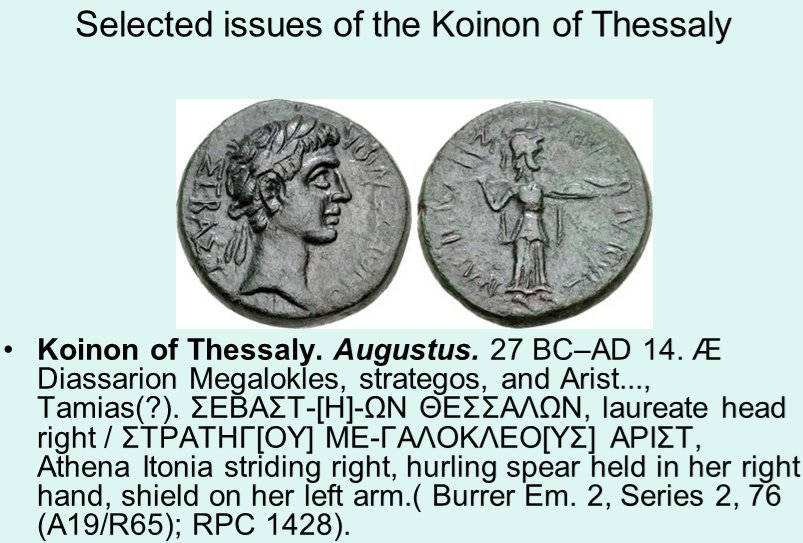
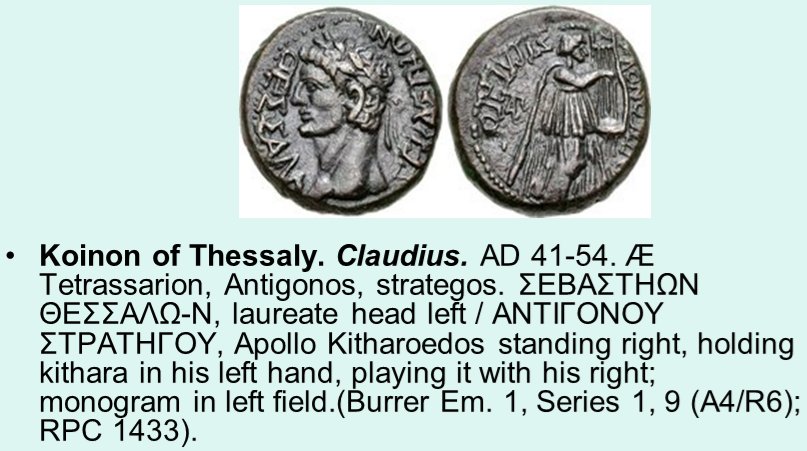
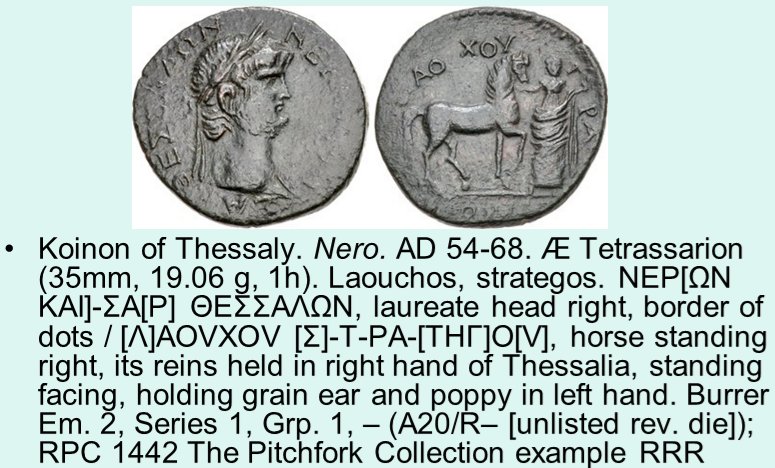

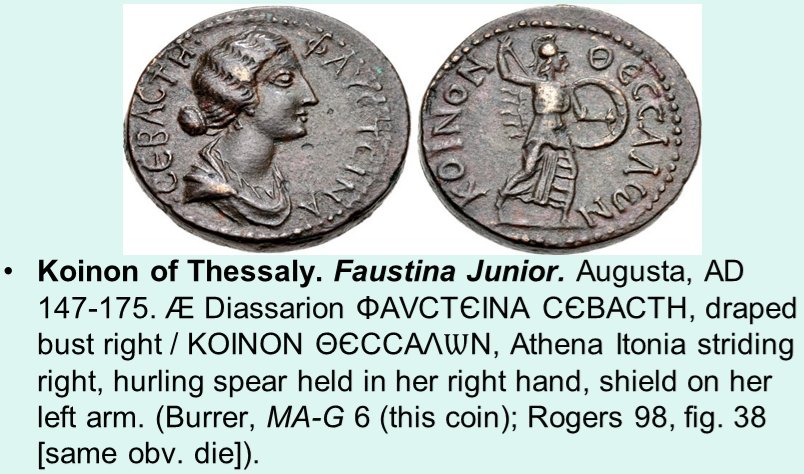
For
the Imperial period, please consult the
following books:
H.
Kramolisch. Die Strategen des thessalischen Bundes vom Jahr 196
v. Chr.
bis zum Ausgang der römischen Republik (Bonn, 1978).
F. Burrer. Münzprägung und Geschichte des thessalischen
Bundes in der
römischen Kaiserzeit bis auf Hadrian (31 v. Chr. – 138 n. Chr.)
(Saarbrücken, 1993).