
was that of Emperor John V111 Palaeologus the penultimate Byzantine Emperor at Ferrara in 1438.
Library
Medallic Art and Meszaros by Phil Benjamin.
Exonumia -
According to “The
International Encyclopaedic Dictionary of Numismatics” by R.Scott
Carlton this
term was coined By Russell Rulau in 1960 to refer to numismatic items
other
than those issued by a government for circulation as money. This is a
broad
term and people differ as to its inclusiveness.
A number of Italian Renaissance artists
followed his example and one of the earliest and best followers was
Matteo de’
Pasti whose medal of a very interesting nobleman, Sigismondo Malatesta 
(The
Wolf of Rimini), who was twice excommunicated, is very similar to
Pisanello’s
of the same man.

The next image is of a 19th century cast copy
of de’ Pasti’s medal of Isotta degli Atti

who
was Malatesta’s mistress at
twelve years of age, bore him two children and later became his third
wife.

The
reverse shows an elephant walking across a field of flowers being a
representation
of strength, fame and even immortality and traditionally associated
with piety
and chastity and having the maker’s name and the date 1446. Having
heard about
the relationship you can make up your own mind about the reasons for
this
legend and odd reverse.
His
first two wives died in mysterious circumstances and there has always
been
speculation that Malatesta had them killed. His was an interesting life!
After 1440 the art of the medal spread
fairly quickly throughout Europe.
As
occurred with other aspects of the enlightenment new inventions allowed
a wider
circulation and
appreciation in the community and the invention of the screw
press in the 16th century enabled larger volumes of medal
production
and with better detail as the medals were struck rather than cast.
In the 17th century Pieter van
Abeele, a Dutch medallist, invented the repousse method of making
medals. He
pressed both sides of the medal separately and then joined them by a
metal rim.
This rim required a small hole for the hot gas, formed when the rim was
attached, to escape. The next three slides show the repousse medal by
Abeele of
Charles 11 leaving Holland from Scheveningen to reclaim his throne on
June 2,
1660. 70mm, silver, Obverse Charles 11 large bust, wearing a long wig
and a
medal on a chain, three quarters right and armoured; Reverse shows a
fleet of
ships with victory above with a scroll inscribed SOLI DEO GLORIA – TO
God alone
the glory.


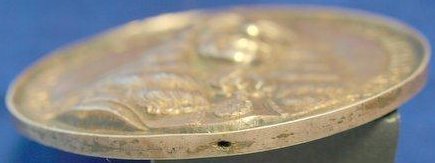
Eimer 210 plate 24.
As a form of art the medal followed all the
contemporary fashions in art over the years from classical,
neo-classical, art Nuevo,
art deco, abstract, etc., and are now produced in many different media
from
metal to glass , acrylic, porcelain

(Cook by Wedgewood) and others.
My main interest of recent times is the Art
Medallion, and especially those of Michael Meszaros and of his father,
Andor;
both struck and cast.
Ray Jewell wrote an article in Volume 2 of
the Journal of the Numismatic Association of Australia concerning
Michael in which
he interviewed Michael and showed a range of his work.
In discussions with Michael he has impressed
upon me the limited canvas and shape of the medallion and how simpler
shows
more or as he said in his interview with Ray Jewell, the making of
medallions has
”made me aware that good art is in many ways a subtractive process – I
keep
taking elements away until I cannot take any more away without the work
falling
apart”.
I never met Andor and I am, I believe, the
poorer for this. Andor was a graduate in Architectural Engineering who
was born
in Budapest, trained in his sculpture in Paris, Vienna and Budapest and
emigrated to the Antipodes in 1939. He had a tough time here; this
country being
fairly culturally bland at that time. He then tried the UK but over
there he
was “doubly alien, not only a Hungarian, but an Australian as well”. He
then returned
to Australia and made a life as a sculptor.
His
attitude to the medallion making is summed up in the following from one
of his
lectures –“What chamber music is in relation to music generally, or the
sonnet
to poetry, is the art of the medallion to sculpture --- medallion
making is an
art form in its own right, somewhere between the two dimensional
painting and
the three dimensional sculpture in the round”..
Michael
I have met and I enjoy discussing his passion with him. He was born in
Melbourne, qualified as an architect and has trained in Rome and is a
full time
sculptor who worked with his father until he died in 1972 and since
then he has
been in solo practice.
To me both have undoubted artistic ability
as shown in their ability to show the essence of their portrait
subjects and in
the large number of public sculptures in Brisbane, Sydney and
Melbourne. I love
their work. Andor seems to me to show more of the spirituality of his
prewar
era and Michael shows more of a modern whimsical clarity but still with
a
thoughtful insight in his creations.
I
choose from amongst my holding a number of
their works for appreciation.
 Andor
Andor
Portraits

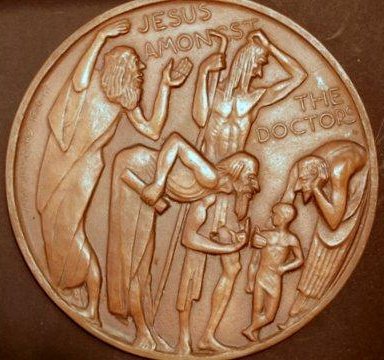
Sir Earle Page –Bronze, 69mm
and cast in 1958, Carlisle 1958/1 – Michael thinks this was probably
his father’s
only double sided casting because they are technically difficult. Large
medallions were placed in various places including the Page Pavilion at
Royal
Prince Alfred Hospital in Sydney and other smaller ones were for
members of Sir
Earle’s large family. The number made is not known.

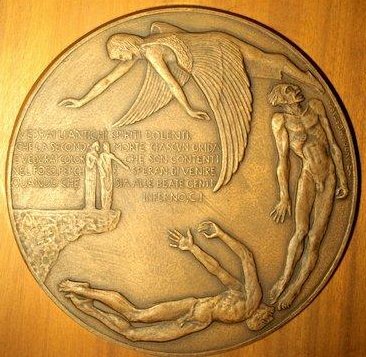
Dante; This piece is a Bronze medal
on wood, 182 mm diameter, by Andor Meszaros and minted by Pinches in
London in
1965. This medal was commissioned by the Italian Institute of Culture,
a part
of the Italian Ministry of Foreign Affairs to mark 700 years since
Dante’s
birth and a copy was presented to the State of Victoria
and is in that state’s museum collection.
This work shows Dante being shown through
the underworld , purgatory and into Paradise by his guide Virgil. This
“Divine
Comedy” by Dante is one of the great literary works of the world over
14,000
structured lines of poetry written in ordinary Italian; whereas if it
had been written
in Latin it would have been called the “Divine Tragedy”.
Next are some of the stations of the
cross

11 (1943),12 (1952)& 14 (1948) 63mm,
bronze made in various sizes and metals. The 14 stations were made by
Andor
over a thirty year period and have been variously named ’the Canterbury
series’
and ‘The Stations of the Cross’.
They were not made in chronological order but
as the spirit moved Andor. The first was Christ before Pilate in1942.
They, like all Andor’s medals, have a
distinctive style and when one is used to his style it is an
interesting
exercise to browse through Les Carlisle’s magnum opus and pick out
Andor’s
medals without reading the description first.
Next,
a cross between Nuevo and deco:
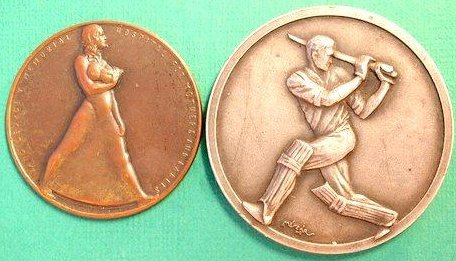
Maternity
and The Cricketer.
Both of these medals show how Andor has
adapted the form to the shape of a medal. Both show the plain lines of
art deco
with the flow of late Art Nuevo.
For Artistic works:
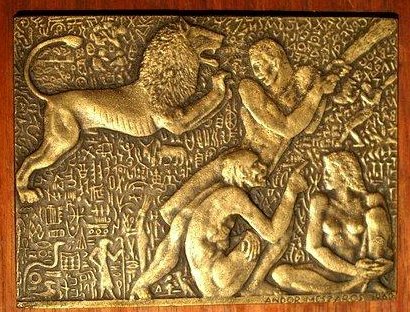
Origin of communication This is a struck version of a
larger cast
plaque which Andor submitted as a group of seven designs (each to be
13X5 feet)
for consideration as murals for the external walls of the National
Library in
Canberra but he did not win the project. However, as smaller plaques
they have
found their way into numerous collections. The plaque shows the action,
talking
(the woman being told the story) drawing (rock art), hieroglyphics,
cuneiform,
idiograms and other notation forms of communication allowing
communication of
ideas from the direct representational to the abstract concept.
Commemorative:

1956 Olympics participants: 63
mm, bronze, mintage of 12,278, C 1956/5.
This
is his, perhaps best known medallion.
Finally there is the recent release by the
RAM of Andor’s designs for our

decimal
currency, which I prefer to those chosen.
We
now move to Michael
From
Michael, a portrait:
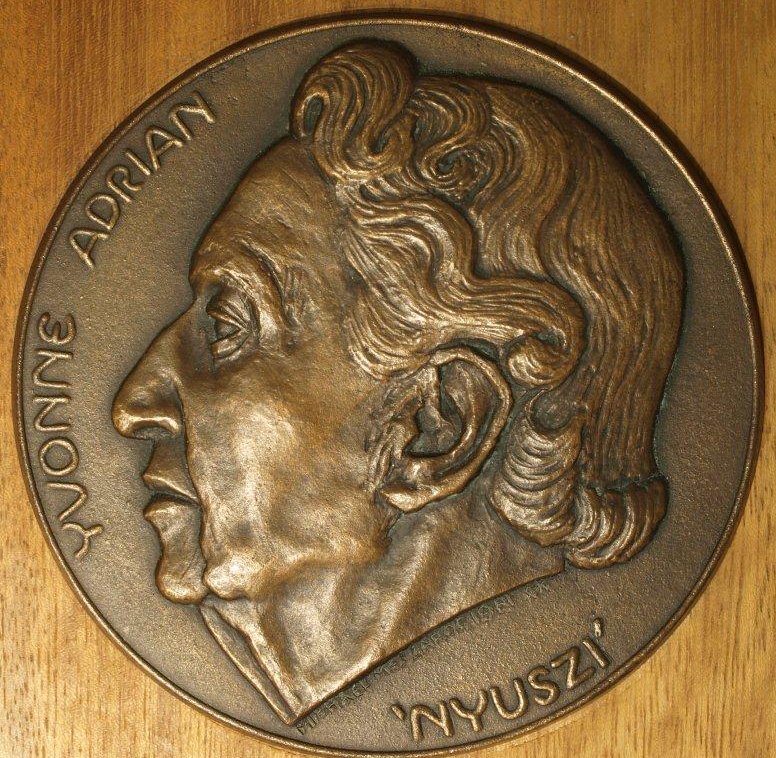
Yvonne Adrian
148mm, bronze and I quote from Michael - “I made this portrait of
Yvonne Adrian
(anglisized from Adorjan) who was probably my oldest friend in that she
was the
wife of the Hungarian doctor who delivered me at the Chelsea Hospital
here in
Melbourne. Her pet name was “NYUSZI”, which means bunny, rather than
rabbit in
Hungarian.
I
did it as a present because of my long friendship with her.
The medal you bought was a casting bought
from me by a friend called Oscar Gimsey, another Hungarian architect
who was
also a great friend of Yvonne. His wife sold a number of medals at the
last Noble
sale which had been collected by Oscar, now deceased, and which she no
longer
wanted,.
Yvonne
was a sort of honorary group grandmother to a number of Hungarian
Australians
like me, and was much loved by everybody.
She was a grand cook who used to invite me,
and later my wife, to wonderful dinners.
I
think I made four castings. Her son has one, I have one and there is
one Yvonne
had herself as well as the one you have.
Yvonne once told me a story that during the
war all telephone conversations had to be in English. She was talking
on the
phone in her heavy accent when the operator interrupted and said “You
must
speak English’ , Yvonne replied - “But I Am!””.

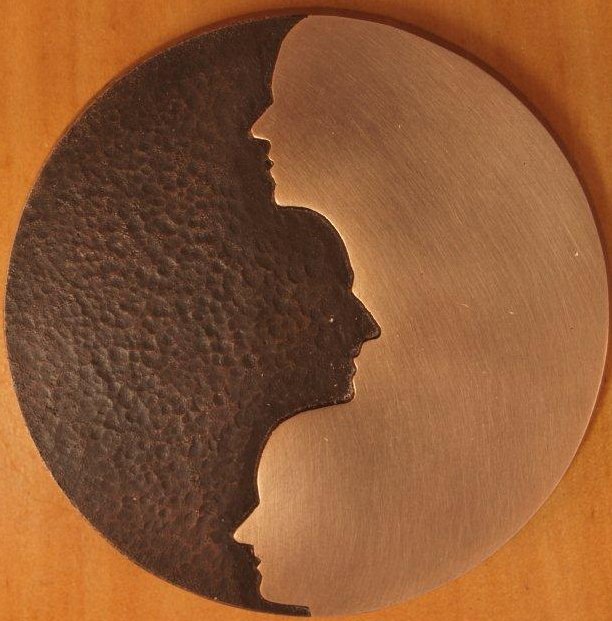


For
Artistic we have:-

The
Trumpeter is perhaps a small misnomer
but one of Michael’s favourite
creations and the

serpent is
ideally suited to the medium.


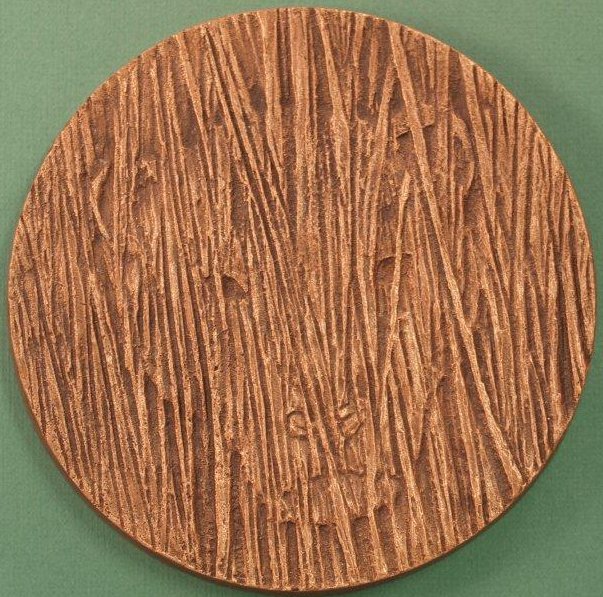
The tiger (or lioness) in the grass is
a comment on natural camouflage.
Finally
as an affinity with Andor’s work
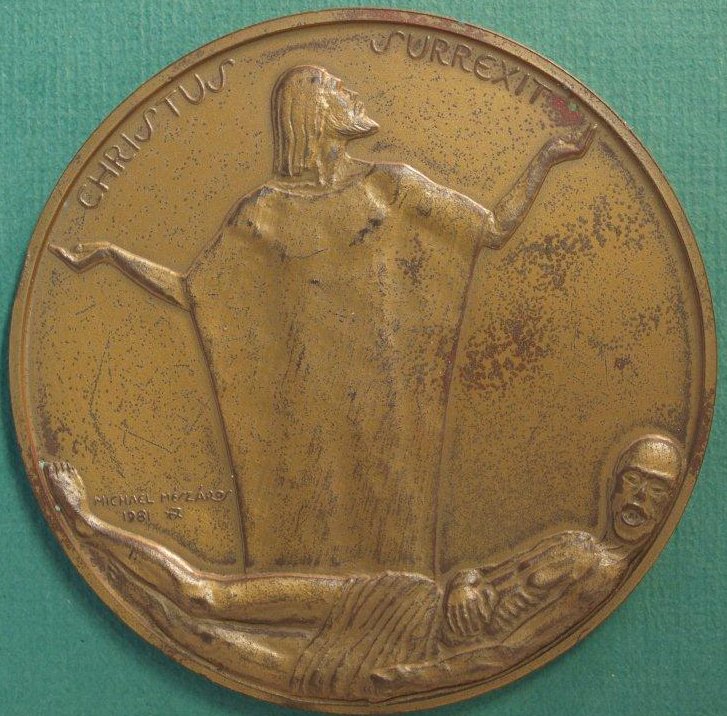
15th
station of the cross. This last piece by Michael shows his ability
to fit
in with his father’s style in making the final station of the cross.
The
resurrection was done at the instigation of the Priory School in
Adelaide
(1981) when they bought a set (7 inches (17.7cm)) of
Andor’s 14 stations of the cross. Michael says that theological
thinking had moved on to include the resurrection as a Station. He has
also made
the point that the number of Stations has varied between 6 to 39 over
the
centuries.
Journal
of the numismatic Association of Australia Vol 2
Andor
Meszaros by Tihamer Wachtel
Personal
Communications