The Australian Numismatic Society
Library
Pre & Post Cook – the
mapping of Australia, a numismatic perspective.
Peter Lane
For centuries maps depicting Australia have appeared on coins and
medals although rarely if at all have they been studied by scholars.
Perhaps this is because of their limited contribution to cartography as
they mainly were used in a political sense or collectors and academics
are simply unaware of their existence. All the pieces are scarce and
some very rare.
Rather than telling the story of mapping and charting our coastline
which has been recorded elsewhere many times I have focused on the
circumstance why the coins and medals were issued. There are no
catalogues on this subject. This article also records two associated
pieces for the sake of completeness. The specimens date from 149 AD,
when the concept of a southern land was first thought of and up to the
mid-1820s when the world coastlines were virtually fully mapped. The
specimens illustrated here are not a full listing of this topic but is
a representative one.
The Examples
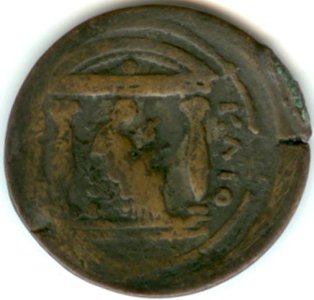
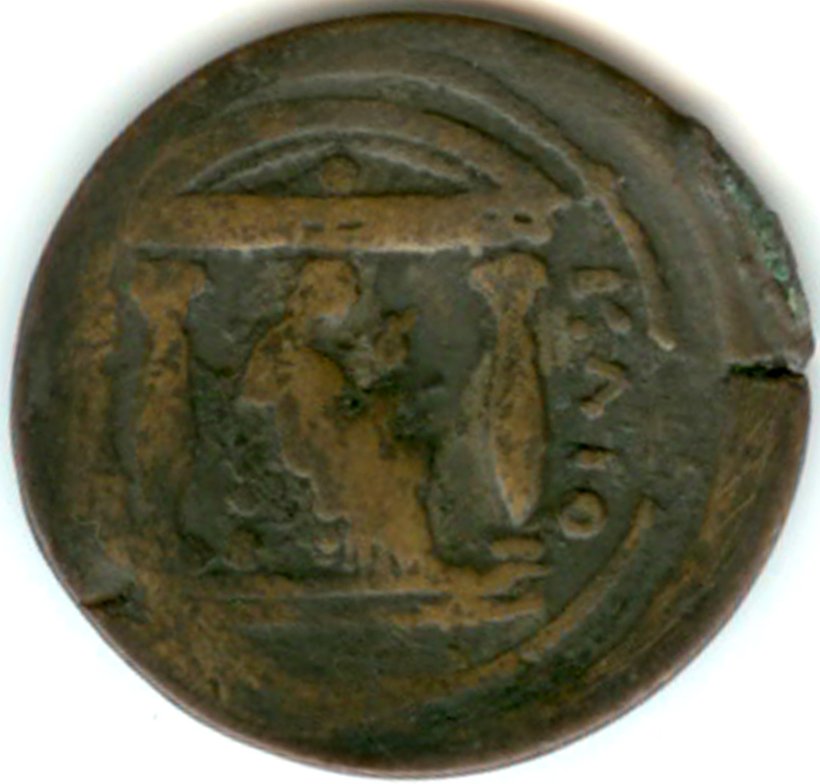
Antoninus Pius, bronze drachm, Alexandria Mint, Egypt, Year 12 of reign
(circa 148/149 AD).
Obverse:
laureate head of Antoninus Pius, facing right.

 Click on images for a larger version
Reverse: Egyptian shrine with two columns capitals of papyrus
head, supporting rounded pediment, disk and uraei on; within a seated
statue of Isis, right, wearing horns, disk and plumes, suckling
Harpokrates who wears skhent.
Click on image for a larger version
metal: bronze
size: 33mm
mint: Alexandria, Egypt
A world map was drawn in Alexandria in 150AD and is known as the
Ptolemy map after the cartographer Claudius Ptolemy who created it.
This world map was the first to show a great southern land mass. This
map was lost and rediscovered in Italy in the middle ages. Claudius
Ptolemy would have used coins like this one as they circulated where he
lived during his lifetime.
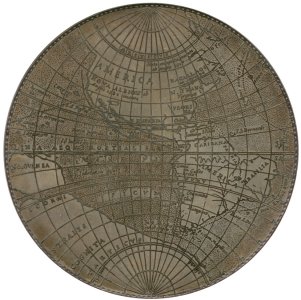
Drake medal (hand engraved) circa
1580
Obverse: Map of the western hemisphere, regions named latitude and
longitude lines. Australia-Antarctica shown as one land mass and this
mass is recorded as ICORNI STRAITS/COGNITA/TARICVS. The large island to
the north is named NO. GUINEA. The map records the route taken by Sir
Francis Drake when he circumnavigated the globe.
 Click
on image for a larger version
Click
on image for a larger version
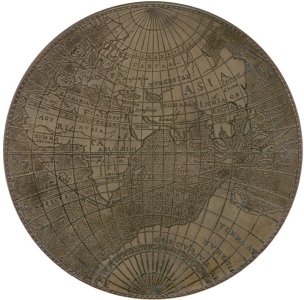
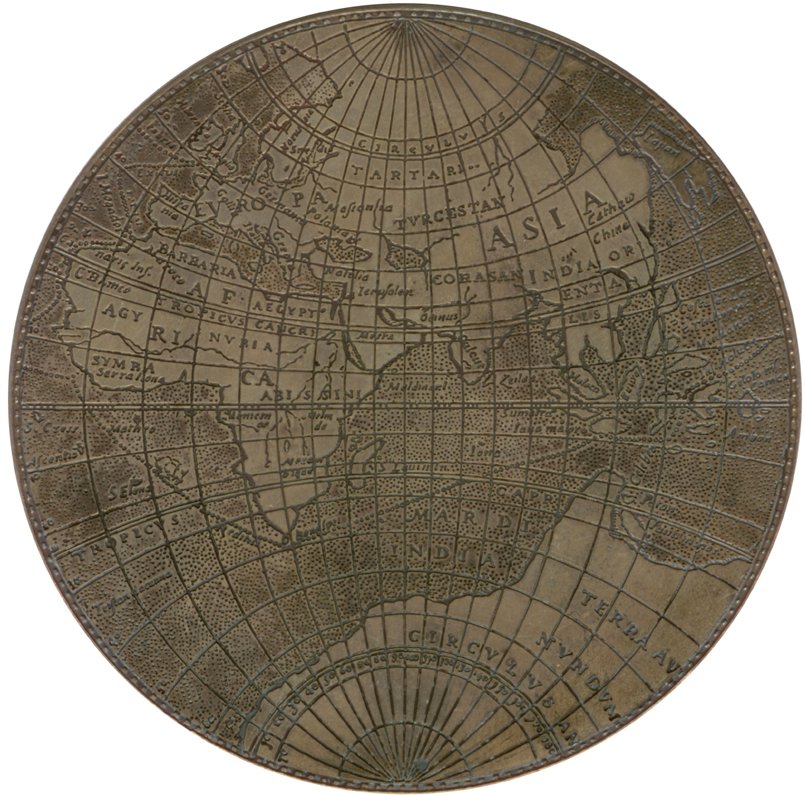
Reverse: Map of the eastern hemisphere, regions named
latitude and
longitude lines. Australia-Antarctica shown as one land mass and this
mass is recorded as TERRA AV/NVNDVN. Two small islands to the north of
Australia are recorded as PETAN and IAUA MINOR (Java) . The map
records the route taken by Sir Francis Drake when he circumnavigated
the globe.
(Photo Courtesy, Dixson Library, State Library of NSW; ZDN/M1144a
&
b)
metal: silver
size: 68mm
engraver: attributed to Michael Mercator, born circa 1565-1570,
died 1600
Other contenders to have engraved the medal are Jocodus Hondius
1563-1612 born Wakken (Belgium) arrived in England 1584 left 1594 and
lived remainder of his life in Amsterdam and 'F.G' a french engraver,
possibly associated with Richard Hakluyt. The main argument in favour
of Mercator is that one medal has his name on it.
The date of the Drake medal has always been circa 1580. I suggest it
may have been created later perhaps 1584 to 1600, as the main engraver
contender would have only been 10 or 15 years of age in 1580, and
Jocodus Hondius only 17.
The Drake medal of which only nine are known was engraved to celebrate
the first circumnavigation of the globe by Sir Francis Drake. Australia
is shown as a great southern land mass, at that time still unchartered.
The two islands that seem to be tucked in the Gulf of Carpentaria (not
yet recorded by Europeans) are named Petan and Laua [Java] minor (the
larger of the two and is thought to be Lombok or possibly Bali).
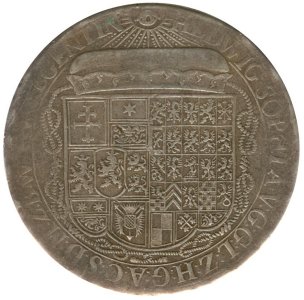
1669 Hesse-Kassel thaler
Obverse: An armorial shield with hat above, all seeing eye
with JOHOVA in Hebrew above, ropes around the shield, Inscription
around HEDWIG SOPHIA. V:G:G:L:Z:H:G:A:C:S:P:M:Z:B:W:V:U. REGENTIN
(Hedwig Sophia, By the grace of God, Landgrave of Hesse, born of the
electoral line of the Margraves of Brandenburg, widow, guardian and
Regent.)
 Click on image for a larger version
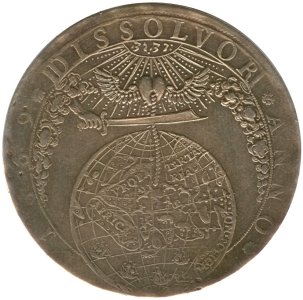
Reverse: A winged heart, sword cutting a cord from world, around
rim
DISSOLVOR ANNO 1669.
metal: silver
size:43mm
Princess Hedwig Sophia was born in 1623and was the younger daughter of
George Wilhelm, Margrave of Brandenburg (1619 – 1640), and his wife
Charlotte Elisabeth of Palatine-Rhine. In 1649 Hedwig Sophia married
Landgrave Wilhelm VI of Hesse-Kassel and became his landgravine
consort. She bore him six children and with the death of her husband,
the Electress ruled for six years as regent from 1663 to 1669 for her
eldest son William VII (1663 – 1670) who died without issue and was
succeeded by his next brother Karl in1670.
1670 Charles II British Colonization medal
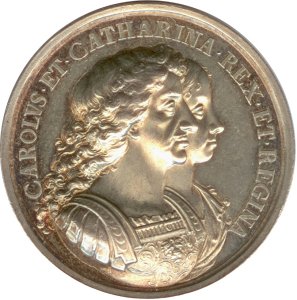
Obverse: conjoined busts of Charles II and Catherine of Braganza
facing
right, he wearing a breast plate and her draped. Around,
CAROLVS. ET. CATHARINA. REX. ET. REGINA [Charles and Catherine
king and queen].
 Click
on image for a larger version
Click
on image for a larger version
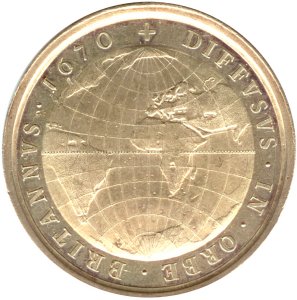
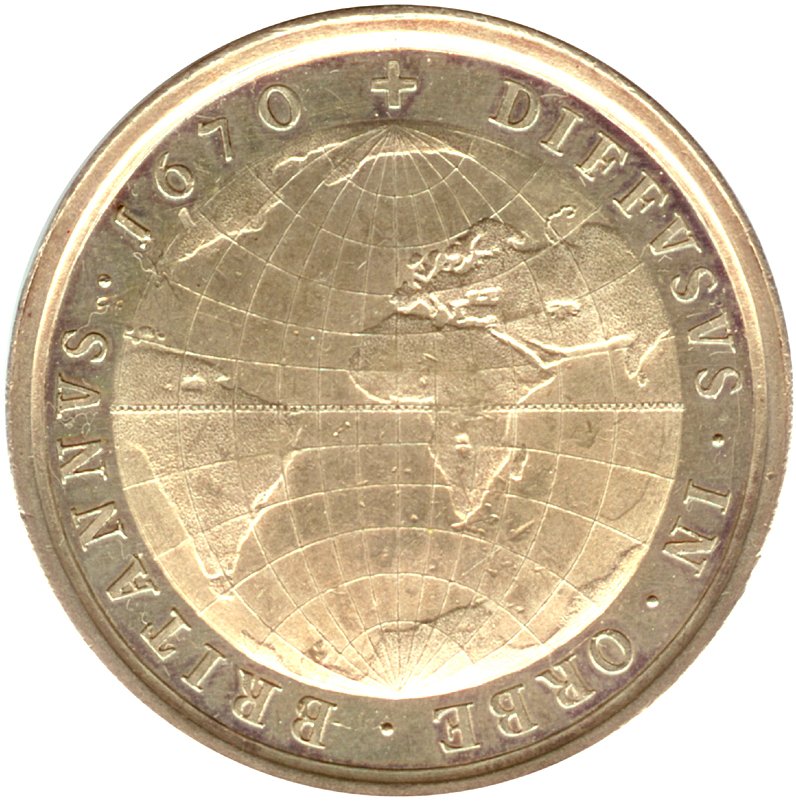
Reverse: a globe depicting all the continents; Antarctic and
Australia
(west coast only) joined as one land mass. Around: DIFFVSVS IN ORBE
BRITANNVS 1670 [Briton spread over the world].
Metal: silver
Size: 41mm
Engraver: John Roettier 1631-1703, born Antwerp, arrived in England
1661.
Reference: Betts 44.
This medal may allude to the dowry brought with Charles’s marriage to
Catherine, which laid the foundation of the British Empire in India or
possibly to the acquisition of territory notably in North America and
Asia.
Charles II (1630 –1685) in 1660 was restored as king of England,
Scotland and Ireland. In 1670 he married Catherine of Braganza (1638-
1705). Catherine was born into the House of Braganza, the most senior
noble house in Portugal which became Portugal's royal house after
Catherine's father, John, 8th Duke of Braganza, was proclaimed King
John IV, after deposing the House of Habsburg, in 1640.
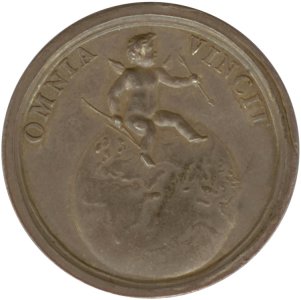
Duchess of Portsmouth medal circa 1673
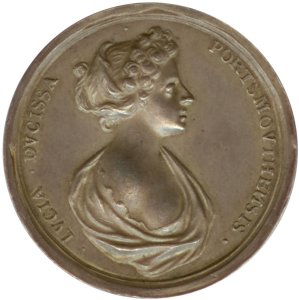
Obverse: Duchess facing right, around, LVCIA DVCHISS
PORTSMOVTHEMSIS
[Lucy, Duchess of Portsmouth]
 Click
on image for a larger version
Click
on image for a larger version
Reverse: Cupid seated, facing right, around, OMNIA VINCIT [[love]
conquers all].
metal: silver
size: 28
engraver: George Bower (1664–1689)
mint: Royal Mint London.
This satirical medal commemorates the title of Duchess of Portsmouth
having been conferred on the 19 August 1673 on Louise de
Kérouaille (1649-1734). The Duchess was a mistress of Charles II
of England. He gave her the titles of Baroness Petersfield, Countess of
Fareham and Duchess of Portsmouth. Around 1675 she brought to Charles'
attention a young Frenchman who proposed a solution to the longitude
problem. While the Frenchman's proposal was ineffective, it led Charles
to establish the Royal Observatory, Greenwich.
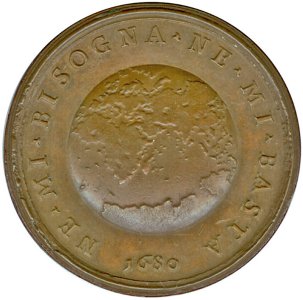
1680 Queen Christina medal
Obverse: Head of Christina facing right, around: REGINA
CHRISTINA. On truncation: IH [engravers initials]

 Click
on image for a larger version
Click
on image for a larger version
Reverse: Eastern Hemisphere, around: NE MI BISOGNA NE MI
BASTA [I
do not need it, it is not enough for me.]
metal: bronze
size: 36mm
engraver: Giovanni Hamerani 1649-1705
Mint: Rome
Christina was born 1622 in Stockholm and died in 1689 in Rome. She was
queen regent of Sweden from 1632, abdicating her throne in 1654 and
converted from Lutheran to Roman Catholicism later in 1654. She spent
her later years in Rome and was a benefactor of arts. She is one of the
few women buried in the Vatican grotto. Christina’s first cousin on her
mother’s side was Hedwig Sophia of Brandenburg who issued the 1669
Hesse-Kassel thaler.
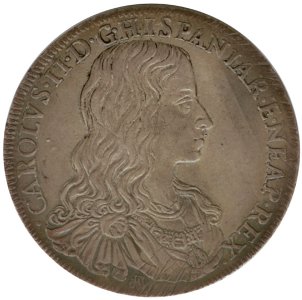
1684 Naples ducato
Obverse: Bust of Charles II bareheaded and draped bust, armored collar
of the Golden Fleece, facing right. Around, CAROLVS . II D.G.
HISPANIAR. NEAP. REX. [Charles II Spain, by the grace of god king of
Naples.] Below bust IM [engraver’s initials].
 Click on image for a larger version
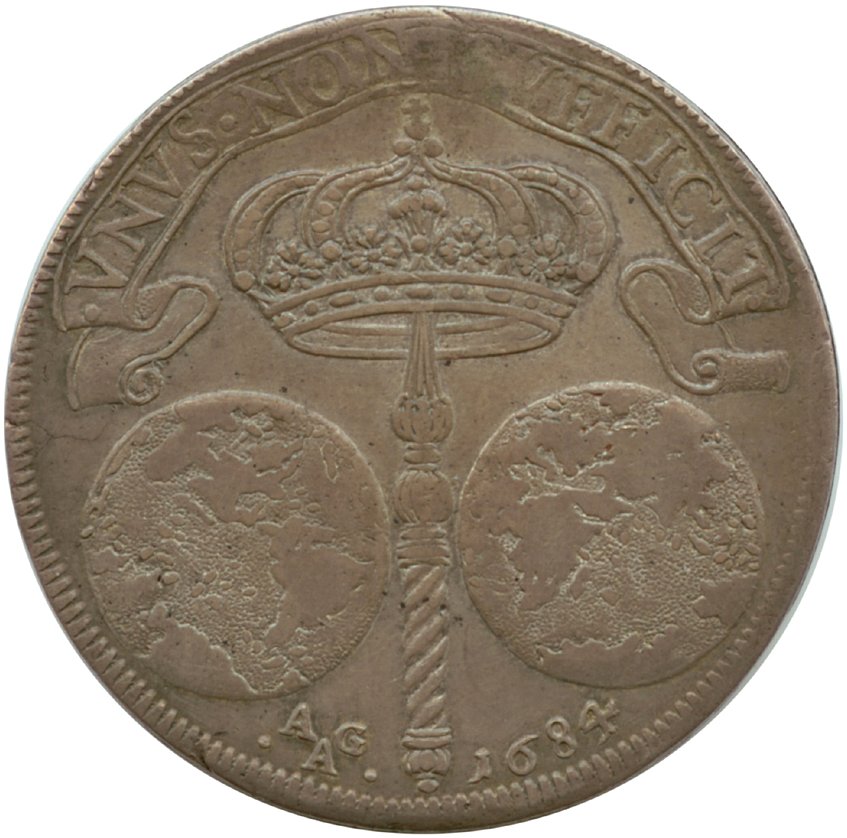
Reverse: A western and eastern hemisphere with a mace between, a
crown
above, with a ribbon above with the words, UNVS. NON. SVFFICIT. [one
not sufficient] Below, AG/A. and 1684.
Metal: silver
Size:41.5mm
Engraver: IM (John Montemein)
Mint: Naples, mint officers: AG [Andrea Giovane] and A [Marco Antonio
Ariani]
Reference: Davenport 4045
This coin is believed to be one of the inspirations for the later
pillar dollar of Latin America. Charles II’s (1661-1700) father died in
1665 and his mother acted as regent until she died 1696 due originally
to his age then his mental incapacity, (due to inbreeding) and then he
ruled in his own right until his death in 1700. His realm included
Southern Netherlands, Spain’s overseas empire in the Americas, Naples
and Sicily. The two hemispheres may allude to his territories around
the world.
1769 Mexico Mint hemisphere dollar (8 reales)
Obverse: Crowned Spanish coat-of-arms, assayers’ initials and value on
either side.
Latin Legend: CAROLVS . III . D . G . HISPAN . ET
IND . REX [Charles III by the Grace of God, King of the Spain and
the Indies] MF [Assayers initials] 8


Reverse: Crowned hemispheres, between crowned and banner-entwined
pillars, all set on ocean. Around: VTRAQUE VNUM [On both sides
Unity] [mint mark] I769
Photo Courtesy Noble Numismatics, sale 92, lot 2774
metal: silver
size:40
mint: Mexico City
This specimen was struck the year before Captain Cook discovered the
east coast of Australia. In 1813 New South Wales holey dollars were
struck from Spanish dollars but only one is known to be struck from
‘hemisphere’ dollars. The hemisphere dollars were minted from 1732 to
1772 at Mexico City, Santiago, Lima, Guatemala, Bogotá and
Potosi mints.
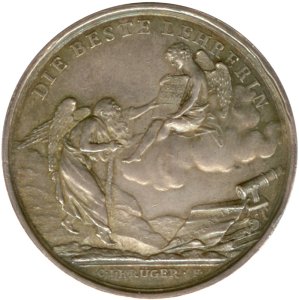
1800 New Century medal
Obverse: Angel on right holding a parchment with the word ERFAHRUNG
[discovery] on it. A bearded angel with walking stick on left, another
parchment below the other with the word AUSTRALIEN on it, a scientific
instrument and books to the right. Around top, DIE BESTE LEHRERIN [the
best teacher]. In exergue engravers name, C.I. KRUGER. F.
 Click
on image for a larger version
Click
on image for a larger version
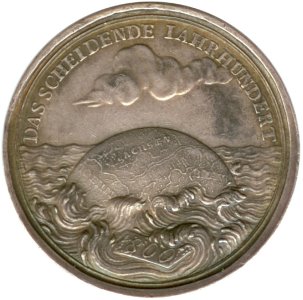
Reverse: A globe with the words SACHSEN [Saxony] BRAN
[Brandenburg] BOEHM [Bohemia] all surrounded by sea, at base a plaque
with ‘1800’. At top DAS SCHEIDENDE IAHRHUNDERT [turn of the century]
metal: silver
size: 40mm
engraver: CI Kruger
Mint: Dresden (Saxony)
This medal alludes to the future scientific importance of Australia as
seen in 1800 by Germans. Johann Reinhold Forster (1729-1798), author
and naturalist, who sailed with Captain James Cook, was appointed to a
chair at the University of Halle, at the time in the Electorate of
Saxony and the capital was Dresden where the medal was minted. This may
have created the focus on Australia. Forster had translated, edited or
reviewed many accounts of voyages to the Pacific including those of
Arthur Phillip, John Hunter and John White.
1802 Peace of Amiens medal
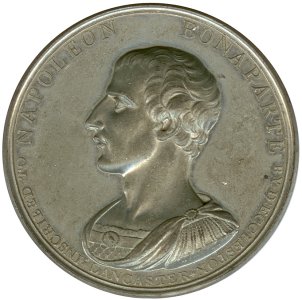
Obverse: Bust of Napoleon Bonaparte wearing Roman costume, facing left.
Around: INSCRIBED TO NAPOLEON BONAPART BY D: ECCLESTON * LANCASTER * On
truncation J. HANCOCK.
 Click
on image for a larger version
Click
on image for a larger version
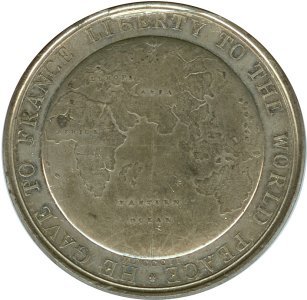
Reverse: Centre, Eastern Hemisphere, with continent’s named,
EUROPE
ASIA AFRICA and EASTERN OCEAN (Indian Ocean) [Australia depicted but
not named, and Tasmania and the mainland were joined] Around, HE GAVE
TO FRANCE LIBERTY TO THE WORLD PEACE in small letters, MDCCCII
metal: white metal
size: 58mm
engraver: John Gregory Hancock
publisher: Daniel Eccleston
reference: Nobles sale 60, lot 985
The Treaty of Amiens ended hostilities between the French Republic and
the United Kingdom during the French Revolutionary Wars. It was signed
in Amiens on 25 March 1802 and the truce only lasted till 18 May 1803.
During this brief cessation of hostilities, on the 8 and 9 April 1802
Matthew Flinders and Nicholas Baudin meet off the coast of South
Australia at Encounter Bay, near the mouth of the Murray River, and
neither were aware of the treaty but they had documents to allow their
ships to travel freely as they were both on an exploring and
researching expedition.
Daniel Eccleston of Lancaster 1745-1821 was an enlightened radical
Quaker and enthusiastic numismatist. The illustrated medal is scarce
and not recorded in most major numismatic catalogues. This is not
surprising as it is a rare medal; in England at the time there was
little interest in acquiring a medal depicting Napoleon as a
hero. Eccleston also issued tokens and other medals and had a
lifelong interest in Aboriginal rights. This attitude and interest in
numismatics is reflected in one of his other medals that depicts George
Washington in a suit of armour (a warrior) and an Indian standing with
head downcast, with the words ‘THE LAND WAS OURS’.
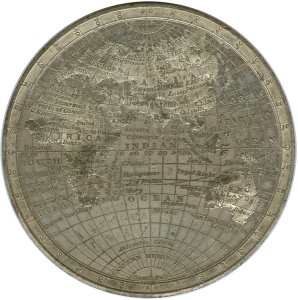
Thomason’s large Hemisphere medal, circa 1820s
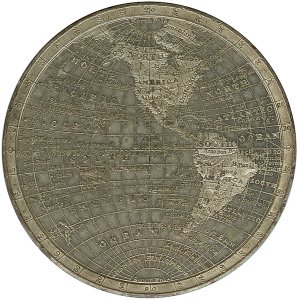
Obverse: A map of the western hemisphere, with numerous place names,
latitude and longitude lines with degrees recorded around the edge.
 Click
on image for a larger version
Click
on image for a larger version
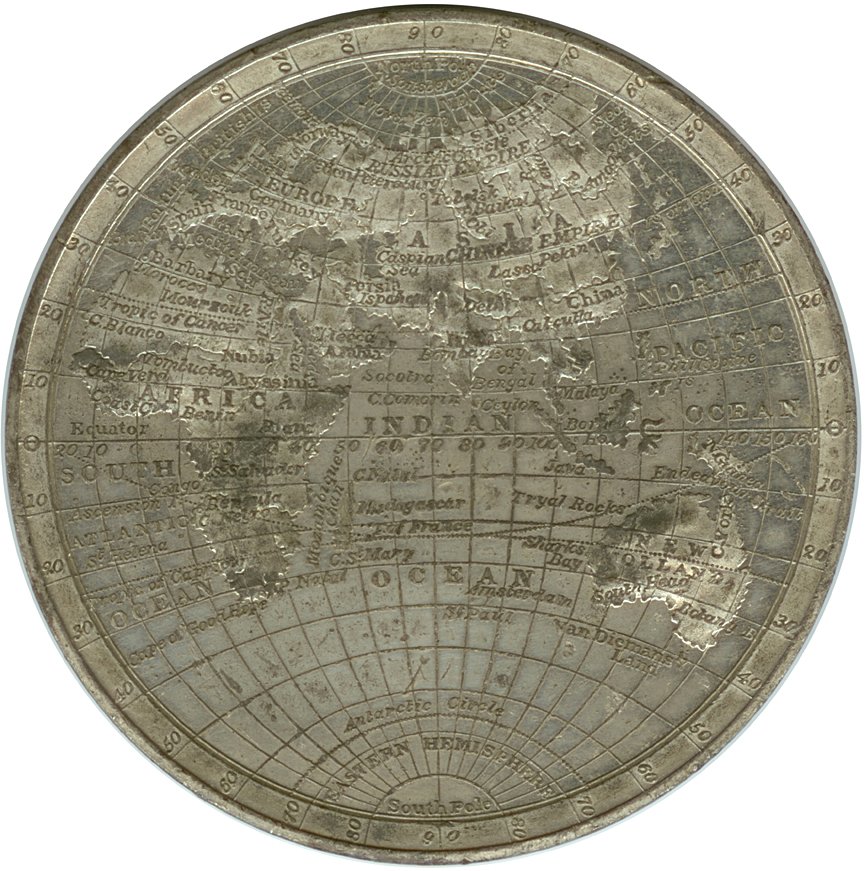
Reverse: A map of the eastern hemisphere, with numerous place
names,
latitude and longitude lines with degrees recorded around the edge.
Australia is shown as one land mass (no Bass Strait). Australia is
recorded as NEW HOLLAND and locations named: VAN DIEMAN’S LAND (sic),
BOTANY B., C. YORK, TRYAL ROCKS, SHARKS BAY, SOUTH HEAD and ENDEAVOUR
STRAIT.
Metal: white metal
Size: 74mm
Engraver: Thomas Halliday
Mint: Thomason, Birmingham
Reference: Eimer 160/1139a
The engraver Thomas Halliday (circa 1780-1854) trained as an engraver
at Matthew Boulton's Soho Mint before establishing his own business in
Birmingham circa 1810 to 1842. He engraved dies for many token and
medallion makers.
Thomason’s factory in Birmingham was established in the early 1790s and
is well known for his inventions including a corkscrew he patented in
1802. In 1807 he added a medal and token department. In 1828 his
workshop finished a series of sixteen medals on scientific subjects,
including hemisphere medals. Of Australian interest it is worth noting
that in 1817 he struck a series of Napoleonic medals for James Mudie
and this venture proved to be a large scale failure. By 1822 Sir
Charles Forbes and the Colonial Office gave Mudie and his daughters,
free travel to New South Wales and a land grant
Sir Edward Thomason (circa 1769 – 1849) originally worked for Matthew
Boulton before setting up his own business. In 1800 he became a
founding member of the Birmingham Philosophical Society.
Thomason’s small hemisphere medal, circa 1820s
Obverse: A map of the western hemisphere, with numerous place names,
latitude and longitude lines with degrees recorded around the edge.
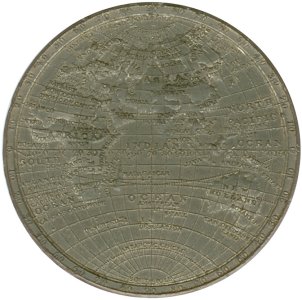
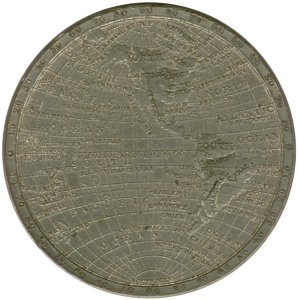 Click
on image for a larger version
Click
on image for a larger version
Reverse: A map of the eastern hemisphere, latitude and longitude
lines
with degrees recorded around the edge. Australia is named NEW HOLLAND
and VAN DIEMANS LAND [sic], and the location of Botany B [BAY] is
named. To the north of Australia, Endeavour Strait is named.
metal: white metal
size: 51mm
engraver: Thomas Halliday
mint: Thomason, Birmingham
Refer previous medal for further information.
Acknowledgements
Matt Cupper, School of Earth Sciences, The University of Melbourne for
information on the Drake medal.
Noble Numismatics, for supplying the image of the 1769 Spanish dollar:
sale 92, lot 2774
(Photo Courtesy, Dixson Library, State Library of NSW; ZDN/M1144a &
b)
Peter Lane is a
Life member of our Society, Honorary Numismatist at the Art Gallery of
South Australia, Past President and Secretary of the Numismatic
Association of Australia, a numismatic expert examiner under the
Protection of Movable Cultural Heritage Act 1986. He has focussed his
research on exploration medals, hemisphere coins and medals, convict
love tokens, and British military medals awarded to those who served in
colonial Australia. He has written a history of the AGSA numismatic
collection which was published in 2017. He can be contacted at
pnj.lane@bigpond.com
Return
to
Library
Return to ANS Main
Page
6th June 2020

 Click on images for a larger version
 Click
on image for a larger version
Click
on image for a larger version
 Click on image for a larger version
 Click
on image for a larger version
Click
on image for a larger version
 Click
on image for a larger version
Click
on image for a larger version
 Click
on image for a larger version
Click
on image for a larger version
 Click on image for a larger version
 Click
on image for a larger version
Click
on image for a larger version
 Click
on image for a larger version
Click
on image for a larger version
 Click
on image for a larger version
Click
on image for a larger version
 Click
on image for a larger version
Click
on image for a larger version