The Australian Numismatic Society
A Paper given at the June
2020 online Conference
Hog Money of the Sommer Isles by Ian Sizeland
Thanks to Columbus in 1492 with his voyage of exploration
and discovery, the world as it was known changed forever.
With the discovery of the Americas it was a race
by the European countries to colonize and expand their domains. The
main players were the Spanish,
Portuguese, French and English, several of the Nordic countries also
vied for a piece of the new world, with Norway, Sweden and Russia
competing.
In 1505 Juan Bermudez of Palos, Castile and
Captain of the ship La Garza discovered the islands that bear his name
- Bermuda.
Peter Martyr d'Anghiera, an Italian historian at
the service of Spain published Legatio Babylonica, in 1511 and lists
"La Bermuda" among the Atlantic islands
Map of Bermuda 1511
legatio babylonica

It is supposed that during his second voyage,
Bermudez purposely left a dozen pigs and sows on the islands so they
would populate and be a source of
food for any shipwrecks.
Over a century later, in 1609, an English ship the
Sea Venture, captained by Admiral Sir George Sommers, left Plymouth,
England, with eight other ships
and towing two Pinnacles of supplies en route to the British
settlement of Jamestown, Virginia.
This was an urgent re-supply mission, the third
since the establishment of Jamestown in 1606.
On 24th July, as they neared their destination,
his ship the Sea Venture was separated from the fleet by a severe storm
and although it was the new
flagship of the Virginia Company, it began to sink and was deliberately
driven onto reefs off the coast of Bermuda, which were then known by
the
English as the Bermoothes or the Hogge Islands.
The crew of 150 remained on the islands for 10
months, taking it as a English possession, they survived on local
produce, coconuts, fish and of cause the wild Hogs.
They constructed two new boats, using local timber
and parts of the wrecked Sea Venture and on May 10, 1610, the new boats
were completed and the
crew finally departed for Virginia.
On arrival they found the Jamestown settlers close
to starvation, about a month later on June 19, 1610, Sir George
Sommers, using one of the pinnacles returned
to the islands to help provision the Jamestown settlement, where he
died soon after arriving in 1611. The islands were renamed the Sommer
Islands by the English
in honour of Sir George Sommers but was rejected by the majority of
Mariners, so the name was restored to Bermuda.
Hogge
Money – Bermuda, 1616:
Control of Bermuda was vested in the Virginia Company from 1612 and
this was replaced by a new company called the Somer Island Company from
29 June 1615.
That company was authorised by James 1 to issue
its own coinage for the islands and took immediate steps to take
advantage of this. Governor Daniel Tucker was
supplied with the coinage and instruction for its issue in the payment
of weekly wages. He arrived in May 1616 with the coins which had been
struck in
'brass' with a silver wash. The coins feature a hog (spelled hogge at
that time) after the wild boars found on the islands. They were known
as Hogge Money
but were not popular, being of base metal in an era when coins normally
contained metal to the value of their denomination. By 1624 their use
had ceased.
The coins or Tokens were made in denominations of
two, three, six, and twelve pence (1Shilling)
The Obverse showed a hog with the denomination in
roman numerals above the animal and the on the six and twelve pence a
legend
"SOMMER ISLANDS" within two circles of beads
Hog (Hogge) Money series –
Bermuda, 1616:
Summary
Threepence and Twopence. Issued by, Bermuda Somer (Sommer) Islands,
1616, obverse.
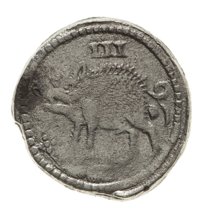

Summary
6 Pence, and 12 pence (1 Shilling) Issued by, Bermuda Somer (Sommer)
Islands, 1616.
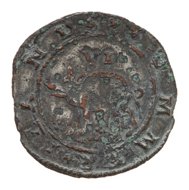

Obverse Description
At centre within a line circle, a hog standing facing left; above,
roman numeral II, III,VI, XII ; around outside the circle, SOMMER ILANDS
Reverse Description
Within a border of beads, a three-masted vessel under sail to left

The reverse displayed a ship, probably the Sea Adventurer, with a
single circle of beads around the border and no legend (the two and
three
pence denominations have an S to the left of the ship and an I to the
right for Sommer Islands
Significance:
The Sommer Islands tokens were the first English coinage made for use
in the Americas.
These crude, light weight coins were not well received and went out of
use by 1624.
The Spanish Dollar replaced the Hog Money and was used throughout the
region.
1 Penny - Bermuda,
1793
After their experience with this so-called "Hogge money," Bermuda did
not have another coin of its own until the 1793 copper penny which was
produced in Birmingham at Boulton's Soho Mint.
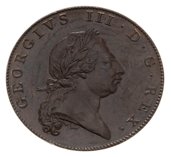

Summary
Proof Penny, Issued by, Bermuda, 1793.
Minted at Soho, Birmingham.
Obverse die by Droz
Obverse Description
Lauteate bust of the King facing right; DROZ F on neck truncation;
around, GEORGIVS III D G REX
Reverse Description
A three-masted sailing ship under full sail to left; land on horizon at
right; above, BERMUDA; in exergue, 1793
Edge Description
Plain
Significance
The colonial agent for Bermuda, John Bridgewood, sought the production
of this issue from Matthew Boulton on 8 November 1792. The coins
were needed quickly so Boulton used an obverse die prepared for a
hoped-for British copper coinage at least two years earlier. That die
was by
Droz who was no longer with the Soho Mint. The working strike coins,
81,942 pieces, were finished by 7 May 1793 with 50 bronzed and 50
copper proofs prepared a few days later.
After 1793, no other coins were produced in Bermuda until the
commemorative crowns of 1959 and 1964.
Proof Coin - Crown, Bermuda, 1959
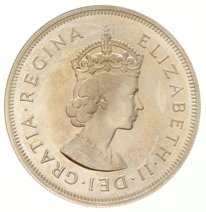

Proof Crown, Issued by, Bermuda, 1959.
Minted at Royal Mint, London
Obverse Description
Crowned bust wearing necklace facing right; around, ELIZABETH II DEI
GRATIA REGINA; inuse on the bust truncation the artist's initials,
CT (Cecil Thomas)
Reverse Description
At centre a relief map of Bermuda; above, a single-masted sailing ship
flying a pendant bearing the Union Jack, an early Bermuda cedar sloop;
below, Bermuda fitted dinghy.
Edge Description
Milled
Significance
The ships on this coin are sometimes referred to as the Deliverance and
the Patience which were built on Bermuda in 1610 by Admiral Sir George
Somers from ships wrecked in a storm and local timber.
Crown, Bermuda, 1964
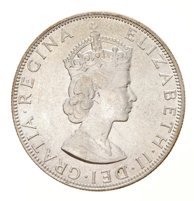

Summary
Crown, Issued by, Bermuda, 1964
Minted at Royal Mint, London.
Obverse Description
Crowned bust wearing necklace facing right; around, ELIZABETH II DEI
GRATIA REGINA; incuse on the bust truncation the artist's initials,
CT (Cecil Thomas)
Reverse Description
The coat of arms of Bermuda dividing the date 1964; the arms is a
shield depicting the wreck of the Sea Venture which was driven ashore
(by
Admiral Sir George Somers of the Virginia Company) on the island in
1609, the shield is supported by a lion (representing England); below
on
a ribbon, QUO FATA FERUNT (translation: Where the Fates carry us);
around above, ONE BERMUDA CROWN
Edge Description
Milled
Significance
This coin, though legal tender, apparently saw little circulation on
the island. Its prime function was in sales to collectors, the choice
of silver as
the metal from which it was struck highlights this role, During the
1960's, the price of silver was rising and the few countries that had
not already
abandoned silver for circulating coins were moving to copper-nickel
alloys for their main coinage needs. Australia persisted with one
silver
denomination, the 50 cent, only for the first year of decimal coinage,
1966.
It was not until 1970, with the introduction of the decimal system in
the United Kingdom, that Bermuda began regularly minting coins.
Though there are no more wild Hogs on Bermuda the history continues
with One Cent coin which depicts a hog on the reverse.
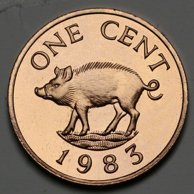

Summary
1 Cent, Issued by, Bermuda, 1983.
Mint not recorded.
Obverse Description
Diademed and draped bust of the Queen facing right; around, ELIZABETH
II BERMUDA
Reverse Description
Wild boar (hog) facing left; around, ONE CENT 1973
Edge Description
Plain
Significance
Decimal coinage was introduced in Bermuda in February 1970, it's dollar
pegged to the US dollar since 31 July 1972
References:
All images courtesy of: Museums Victoria Collections https://collections.museumsvictoria.com.au
Return
to
Library
Return to ANS Main
Page
19th June 2020